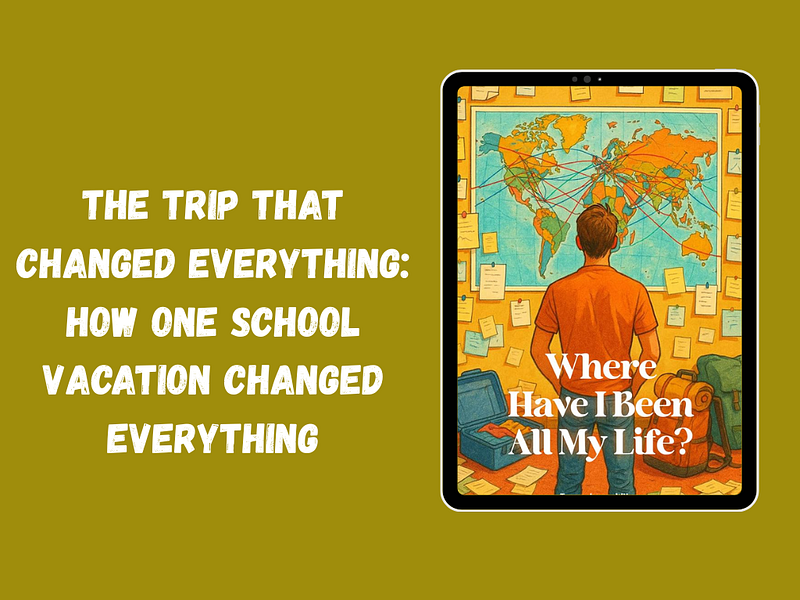
You don’t think your life will change on a cold, rainy morning when your socks are half-wet and your backpack smells like a sandwich from yesterday. Most of the time, great turning points come disguised as normal days. Mine began on a train platform in London — Victoria Station — when steam still hung around and rationing wasn’t just a fun fact from history but a part of everyday life.
Visit: https://trevorjameswilson.com/
It’s hard to explain the hunger that comes from growing up in muted color if you’ve never been in a place where the air feels so gray it might as well be part of the concrete. You don’t realize it when you’re in it, but life just feels flat. Expected. Maybe good enough. Then one day your school offers a two-week trip to the Swiss Alps, and something in your chest starts to flicker like someone is checking the lights to see if a room is worth entering.
At the time, I didn’t know that the little flicker I saw from the platform was a fuse. And once it lit up, there was no turning back.
1. The Drizzly Train Platform That Started It All
Imagine that you’re a kid who has never been anywhere but the next town over, except in books. You’re with a bunch of other kids who mostly signed up because the brochure said there would be snow. The platform is full of fog, noise, and the faint smell of fried food. Teachers are yelling out how many students there are. Someone has already lost a mitten.
You don’t wonder if you should be there. You’re too busy thinking about mountains you’ve only seen in old library copies of Wonders of the World. The pictures never seemed real. More like drawings of things that adults let you look at but never touch.
Amazon: Where Have I Been All My Life
But when you know you’re really on your way to something, even impossible things look different.
The train pulls up with a long, metal sigh, and all of a sudden you’re walking toward something you can’t name yet. If someone had stopped me right then and there and asked, “Why this trip?” Why now? I wouldn’t have known what to say. Not yet. But later, much later, I’d think back and say, “Ah.” That’s when the world fell apart.
It’s strange how clarity works on a delay.
2. When the mountains opened up like a storybook
It wasn’t until we got on the train, the ferry, or even the overnight ride where none of us slept because one boy thought it was funny to whistle every ten minutes that the real shock hit. The next morning, the windows were filled with a kind of light that I couldn’t name.
Not the sun. England had the sun. In a way.
This was not the same.
This was light with a purpose.
As we got closer to the Alps, the scenery didn’t just change; it slowly revealed itself, like it was hiding something. First the rivers, which were green in a way that rivers back home just wouldn’t be. Then the rolling fields, which were too neat to be by chance. Then there was the first hint of the mountains, just the outline. It was like the story was getting better.
And then… the big reveal.
Mountains that seemed to be alive. It was pure white snow that looked like it had been painted, not the dull, tired slush I was used to. Meadows full of wildflowers that were so bright they almost buzzed. Even the cows looked like they were part of a more expensive version of reality.
Imagine thinking that most of your childhood was gray, only to find out minutes later that someone has been hiding the color settings from you.
It felt like that.
And I’m telling you that it changes something inside you. For good.
3. That first feeling of “There’s more out there”
People say that life lessons come from teachers, books, or painful things that we have to go through to grow. They do sometimes. But sometimes they sneak in from the side, looking like scenery.
The Alps were more than just mountains for me. They were a sign. A push. A whisper that said, “Hey, there’s more.” More than what you’ve seen. More than what you’ve been told to expect.
It wasn’t a big, life-changing moment. As I walked through a village that was so clean it felt like a dream, slept in a room made entirely of blonde wood, rode the funny little Bernese Overland Bahn, and learned how cogwheels make trains climb, I was just aware of a quiet hum in the background.
But the message got through.
And this is the part I didn’t fully understand until later: the world becomes your teacher as soon as you decide you want to learn from it. Even if it’s just one trip. Just a second. One surprising detail that makes you look just enough to see what you were missing.
For me, it was the bright green of a river in a city I didn’t know. It was such a strange and electric color that it felt like a dare.
4. The Lesson That Stayed with Him for 70 Years
People expect a clear story when they hear “life-changing trip.” They want to hear about a big, dramatic event, a near-death experience, or a stranger with strange wisdom. That is true sometimes. But sometimes all it takes to change you is to see the world happen in real time.
Even after I traveled to places like Kenya, Japan, and Antarctica, I still thought about that first moment of recognition: “Oh.” The world is bigger than my life. And if I let it, it will change me.*
That first trip showed me how to be interested.
How to be modest.
How to find meaning in small things, like when the Swiss boy gave me a pear as we were leaving his village. Even though it wasn’t ripe, I kept it all the way back to England. The gesture felt like a small ceremony in some way. A farewell.
And as I got older, I learned that some trips don’t end when you get home. They repeat. They affect the questions you ask, the risks you take, and the lines you cross later in life.
When people ask me why I traveled so much, I tell them the truth: I never meant to be a traveler. I just can’t forget how that first trip made me feel.
And it seems that I’m not the only one. One of the first people to read the memoir wrote me a note that said, “Your chapter about Switzerland made me book my first trip at 42.” I didn’t know I needed that push.
That one was very important.
5. A Quiet Invitation to the Reader
This is where I could give you a speech to get you excited about going out and seeing the world. But you don’t need that, and I’m not that kind of writer.
Instead, I’ll ask you something more gentle:
What was your moment? The one that changed the map in your mind.
The memory that comes back to you without you wanting it to.
The one that gently reminds you that you can do more than you think.
You might have already had it. It could be waiting quietly in the wings.
And if this story made you feel something, like that vague spark that used to flicker in me, then your own “Swiss Alps moment” might be closer than you think.
You can join my small group of readers if you want to read more real, messy, human travel stories like this one. I tell you things that brochures don’t. The truth. The good things.
Just say the word, and I’ll save you a spot on the next trip.
Comments
Post a Comment